


Dylan, Guthrie and a renowned Jewish museum connect Oklahoma’s oil capital to Jewish-related music
April 4, 2026
TULSA, Okla. — This city built on oil and cattle between the edge of the Great Plains and the foothills of the Ozark Mountains has emerged as an unlikely nexus of Jewish-themed music in Middle America.
Really, Tulsa?
Yes, a city known as “the buckle of the Bible Belt” offers visitors world-class museums related to the music of Bob Dylan, Woody Guthrie and their respective connections to Judaism, not to mention an entertaining and eye-catching “Jews Rock” exhibit inside one of the top-ranked Jewish museums in North America.
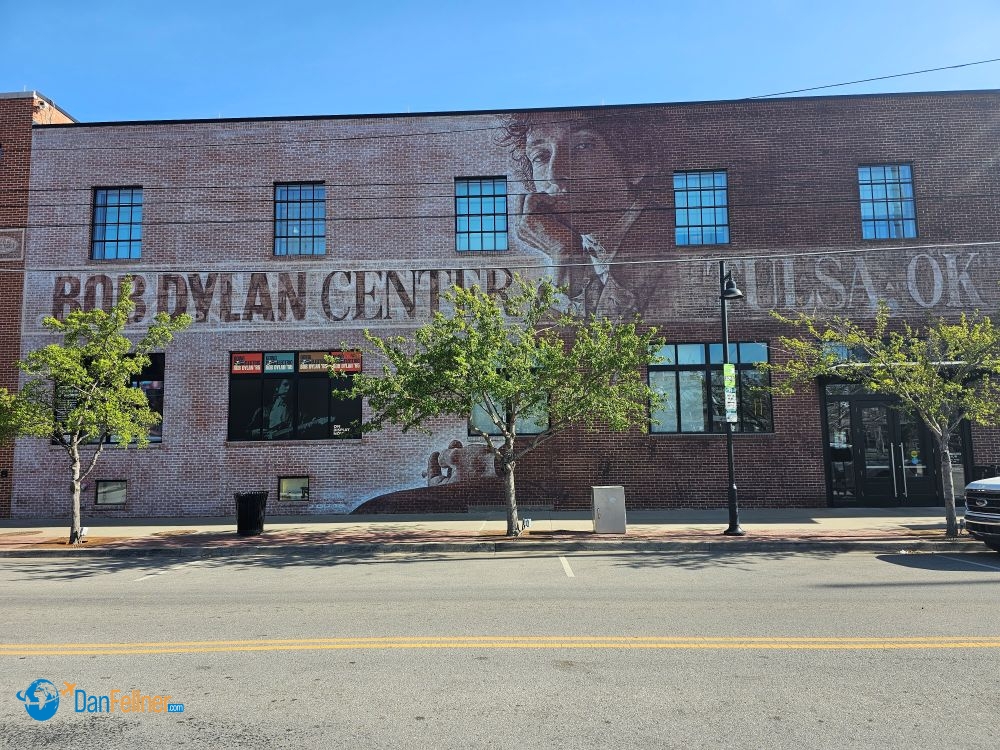
The Bob Dylan Center in Tulsa’s Arts District explores the life and work of the legendary Jewish-born singer-songwriter and cultural icon.
I recently spent three days exploring Tulsa’s music attractions and learned about a surprisingly robust Jewish community that enjoys generous philanthropic support from several local families, most notably oil and banking billionaire George Kaiser, whose parents fled Nazi Germany and settled in Tulsa during the 1940s.
The Kaiser family has not only supported the Jewish community and the local arts, it’s also helped fund initiatives related to early childhood education, eradicating poverty and recruiting Jewish-Canadian immigrants to move to Tulsa.
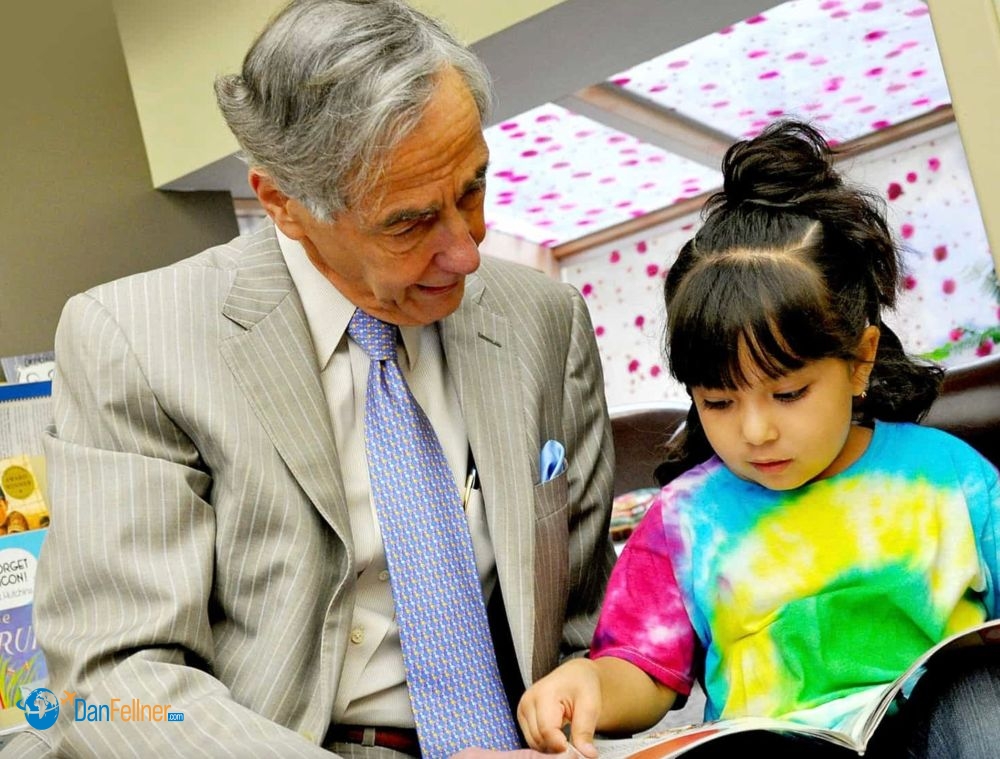
Oil billionaire and Jewish philanthropist George Kaiser has helped fund the arts in Tulsa and initiatives related to early childhood education. (Photo: George Kaiser Family Foundation).
“If you look at what they’ve done for the Tulsa community, it’s exceptional,” says Joe Roberts, executive director of the Jewish Federation of Tulsa. “The vision of the George Kaiser Family Foundation to really shape the future of Tulsa, to bring thought-leaders here, to breathe life into the community — I’ve never seen anything like it.”
It was the Kaiser Family Foundation that helped put Tulsa on the music-map in 2013 when it purchased the archives of the legendary folk singer Guthrie and put them on display in a red-brick building in the city’s Arts District.
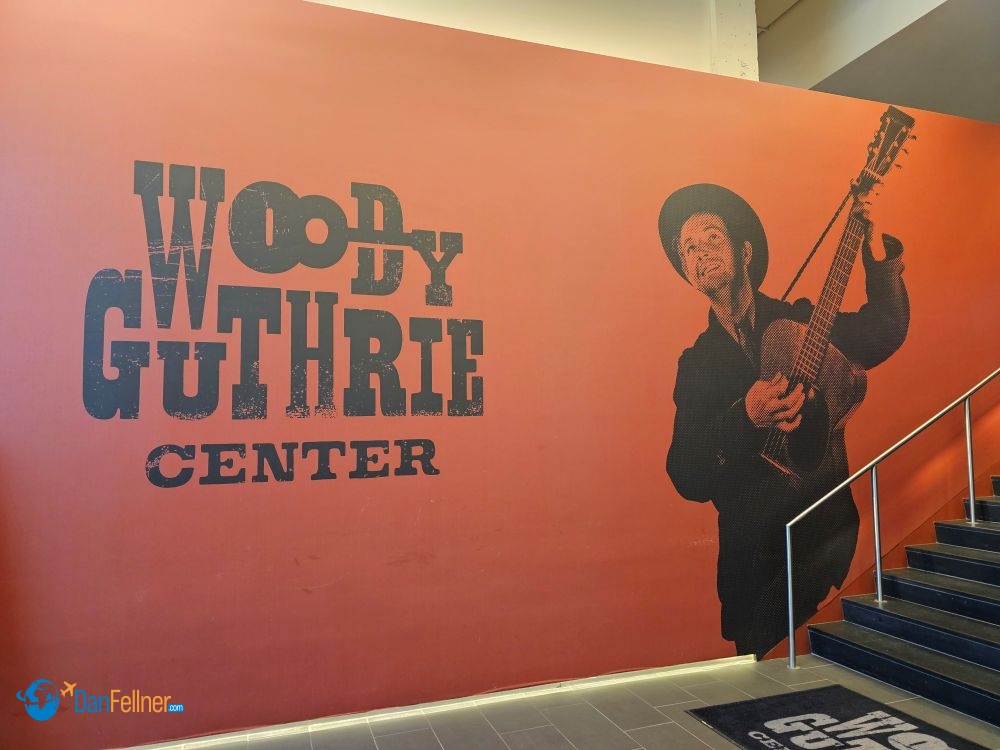
The Woody Guthrie Center in Tulsa celebrates the life of the legendary folk singer who had a strong connection to Judaism.
The Oklahoma-born Guthrie wasn’t Jewish, but his connection to Judaism is as strong as the wind during a derecho – a fast-moving thunderstorm that blows through the Oklahoma plains in the summertime.
Guthrie’s second wife, Marjorie Greenblatt Mazia, was a professional dancer and the daughter of acclaimed Yiddish-American poet Aliza Greenblatt. Woody and Marjorie had four children together (Cathy, their first child, died at the age of 4 in an apartment fire) and raised them Jewish.
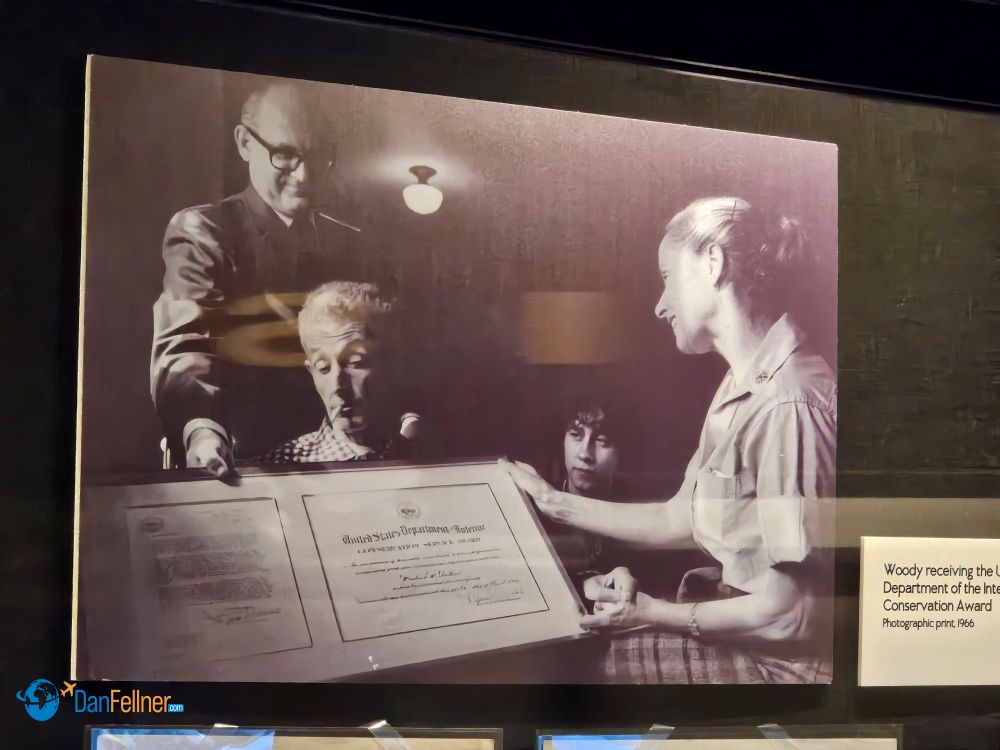
A photo of Guthrie along with his Jewish wife Margorie and son Arlo on display at the Woody Guthrie Center in Tulsa.
One of their children, Arlo, now 78, has enjoyed success in his own right as a folk singer-songwriter. His most famous song, 1967’s “Alice’s Restaurant Massacree,” remains a counterculture staple.
Interestingly, Arlo’s Hebrew tutor and the rabbi who tutored him and officiated at his “hootenanny-style” bar mitzvah in New York was Meir Kahane, who later founded the Jewish Defense League.
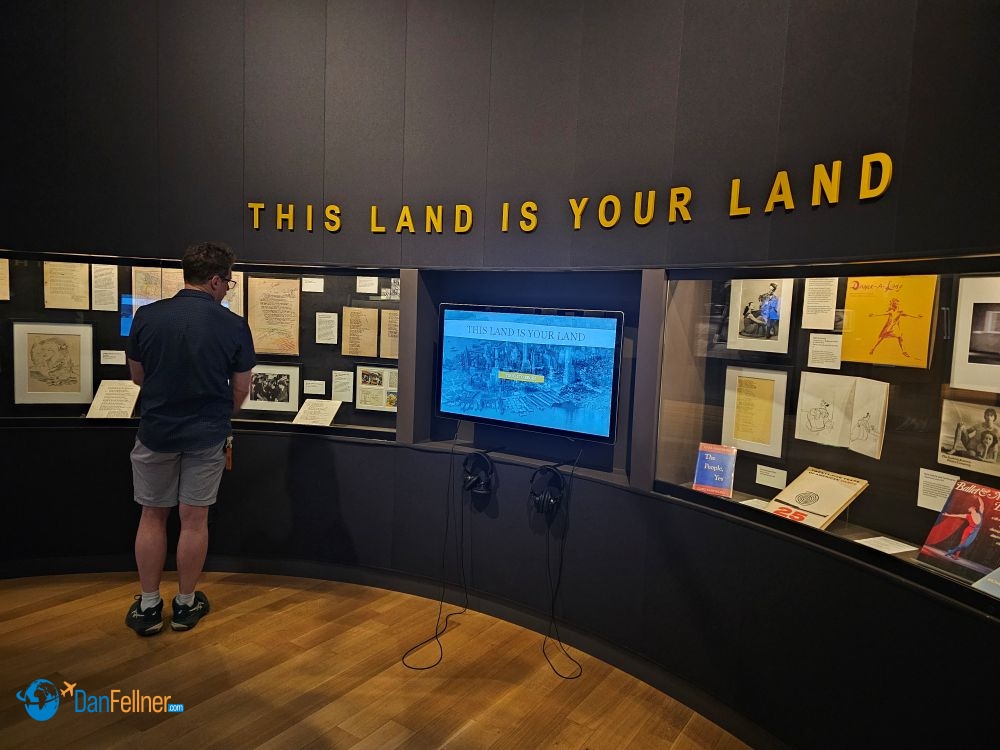
The centerpiece of the Woody Guthrie Center in Tulsa is an exhibit devoted to Guthrie’s most enduring song – “This Land is Your Land” – a folk anthem he wrote in 1940.
Woody died in 1967 of Huntington’s disease at the age of 55; he spent the last 13 years of his life in hospitals. While Guthrie is best remembered for his landmark folk anthem “This Land is Your Land,” he also wrote a unique collection of Hanukkah songs in the 1940s.
“Those Hanukkah songs, he was incorporating them because his wife was Jewish, his children were Jewish and he wanted to explore that connection,” says Cady Shaw, director of the Woody Guthrie Center. “He stayed home with the children a lot and was thinking of ways of connecting with them. I think he immersed himself in that culture.”

Woody Guthrie wrote several Hanukkah songs that were set to music and recorded by the popular Klezmer band The Klezmatics (Photo: Klezmatics.com)
The largely unknown lyrics to Guthrie’s Hanukkah songs were discovered in 1998 by his daughter Nora and later set to music by the popular New York-based klezmer band The Klezmatics on their 2006 album “Woody Guthrie’s Happy Joyous Hanukkah.”
A digital exhibit at the Guthrie Center called “Following in Woody’s Footsteps” shows the Klezmatics – along with such diverse artists as Joan Baez, John Mellencamp and Peter, Paul & Mary — as one of numerous musical acts greatly influenced by Guthrie.
I had the opportunity to see The Klezmatics perform several of Guthrie’s Hanukkah songs — including the catchy “Honeyky Hanuka” — at a 2025 concert in Scottsdale, Ariz. A children’s picture book based on the song was released in 2014.

The popular klezmer group The Klezmatics performs Woody Guthrie’s Hanukkah songs at a concert in Scottsdale, Ariz.
In 2016, Bob Dylan visited the Guthrie Center and was so impressed with the way his musical idol’s legacy was honored, he agreed to sell his own personal collection of some 100,000 artifacts to the Kaiser Family Foundation.
Six years later, the two-story Bob Dylan Center – full of the musician’s photos, recordings, films, manuscripts and Dillon’s own paintings — opened right next door to the Guthrie Center.
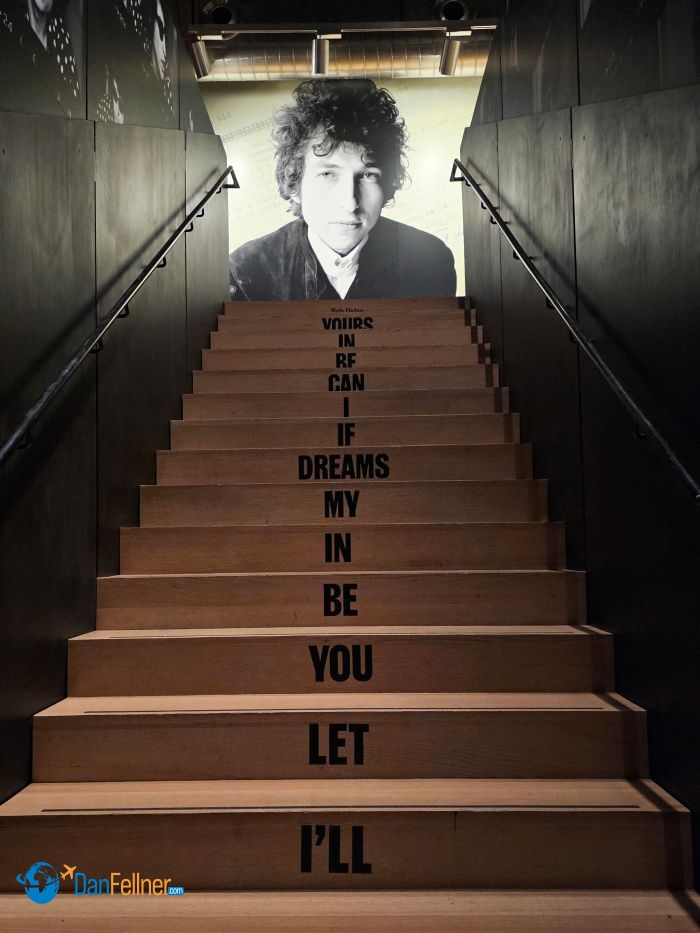
A staircase at the Bob Dylan Center in Tulsa displays the lyrics from one of the musician’s songs — “Talkin’ World War III Blues.”
“With Guthrie being so important to Dylan after all these years, Dylan really seemed to love the idea of his collection essentially being under the same roof,” says Steven Jenkins, director of the Dylan Center. “So everything came our way.”
Dylan, born Robert Allen Zimmerman in Duluth, Minn., was raised in the iron-mining town of Hibbing in northeast Minnesota. He grew up in a kosher home, was bar mitzvahed and spent his summers at the Herzl Jewish camp in Wisconsin. There are photos on display at the museum of Dylan at the camp with friends and later attending a Hillel event as a student at the University of Minnesota; he dropped out after his freshman year to pursue a music career in New York.
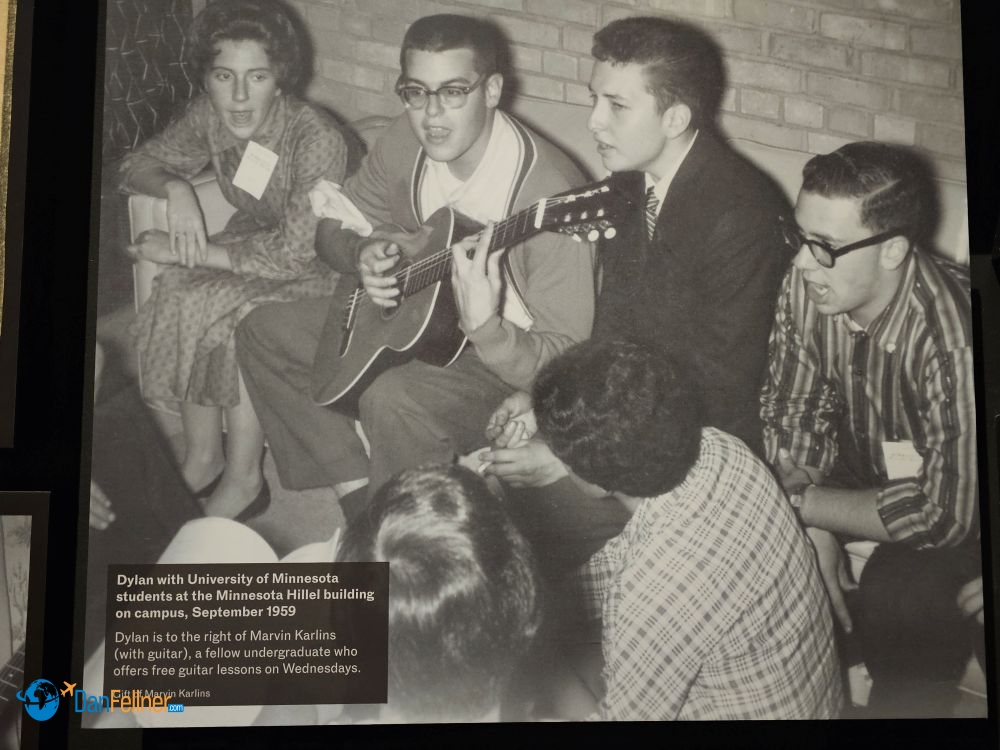
A photo of Bob Dylan at a Hillel event at the University of Minnesota in 1959 on display at the Dylan Center in Tulsa.
Despite his upbringing, Dylan experienced a well-documented period as a born-again Christian in the late 1970s, releasing several gospel albums. He later returned to his Jewish roots and has been seen celebrating High Holiday services at Chabad synagogues.
During his storied career, Dylan has written several Jewish-themed songs, perhaps none more significant than 1965’s “Highway 61 Revisited.” The song is the title track of an album on display at the Dylan Center, which marked Dylan’s transition from folk to a groundbreaking, blues-based rock sound.
“Highway 61 Revisited” begins by paraphrasing lines from Genesis: “Oh, God said to Abraham, ‘Kill me a son’ / Abe says, ‘Man, you must be puttin’ me on.'” There are references to Jewish spiritual concepts throughout “Highway 61 Revisited,” which was voted the greatest Jewish pop song of all time by The Forward.
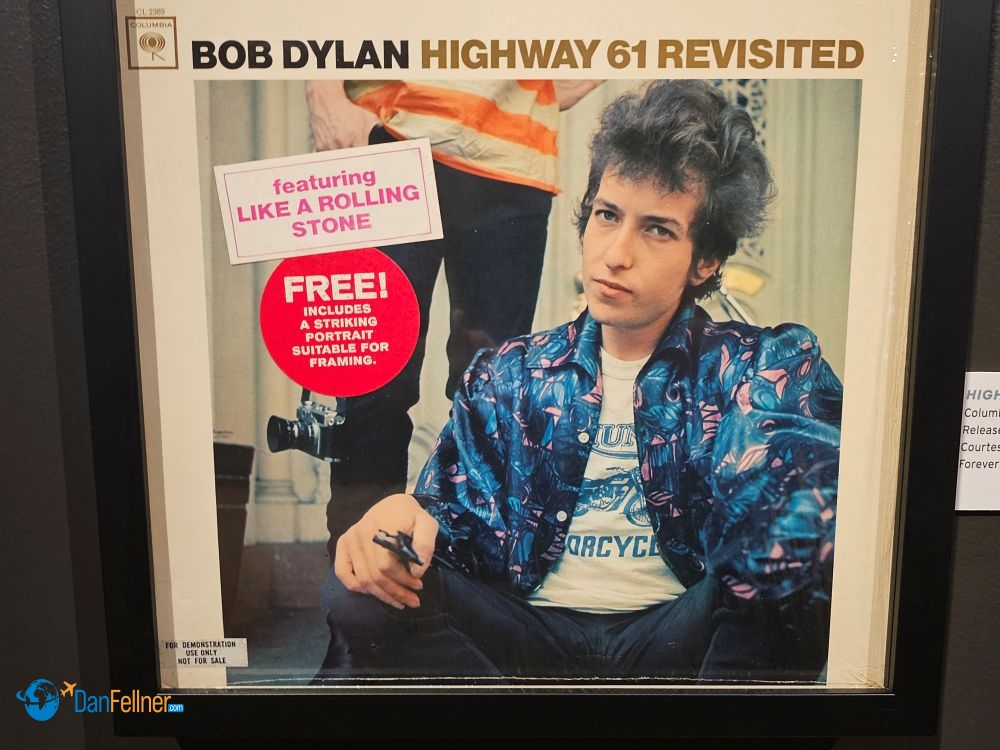
Dylan’s title track from the 1965 album “Highway 61 Revisited” was voted the greatest Jewish pop song of all time by The Forward. The album cover is on display at the Dylan Center in Tulsa.
Dylan’s 1983 song “Neighborhood Bully” is unapologetically pro-Israel. The song was co-produced by Dylan and Mark Knopfler, the son of a Hungarian Jew. Knopfler was later inducted into the Rock and Roll Hall of Fame as the lead singer of Dire Straits.
From the Dylan Center, it’s a 15-minute drive south of downtown to see yet another Tulsa connection to Jewish music. Inside the impressive Sherwin Miller Museum of Jewish Art is an entertaining and popular “Jews Rock” exhibit showcasing Dylan, Neil Diamond, Simon & Garfunkel and several other prominent Jewish musicians.
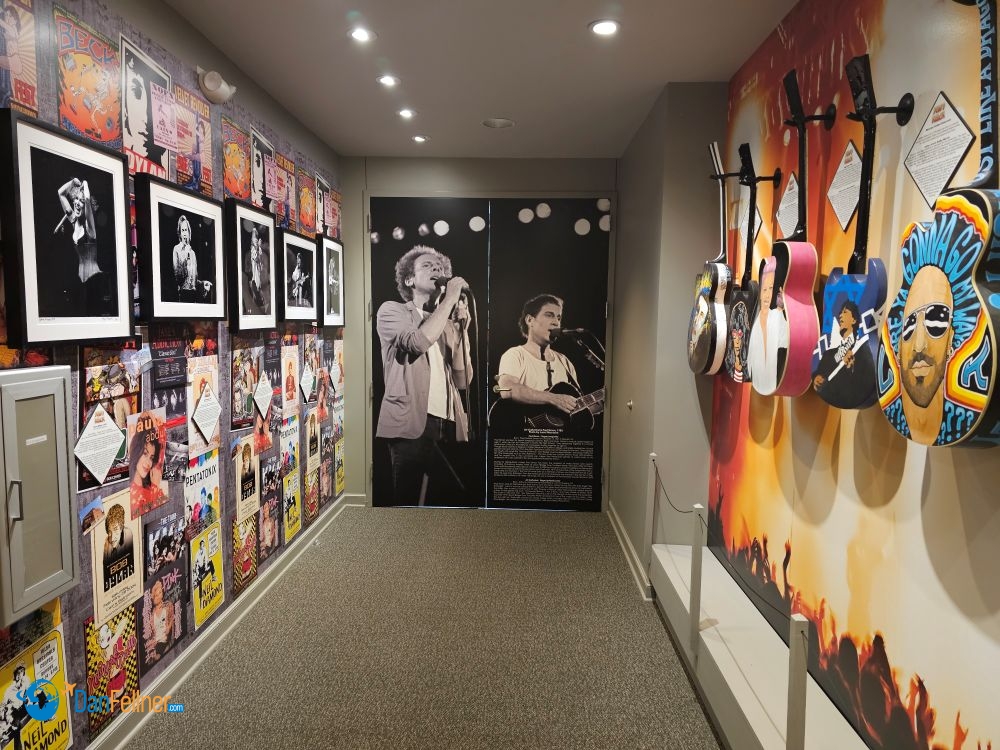
The popular and eye-catching “Jews Rock” exhibit at the Sherwin Miller Museum of Jewish Art in Tulsa.
The exhibit features the photos of journalist Janet Macoska and several hand-painted guitars, including one of Dylan painted by Cherokee artist Bryan Waytula that includes the titles of Dylan’s most popular songs beneath a star of David.
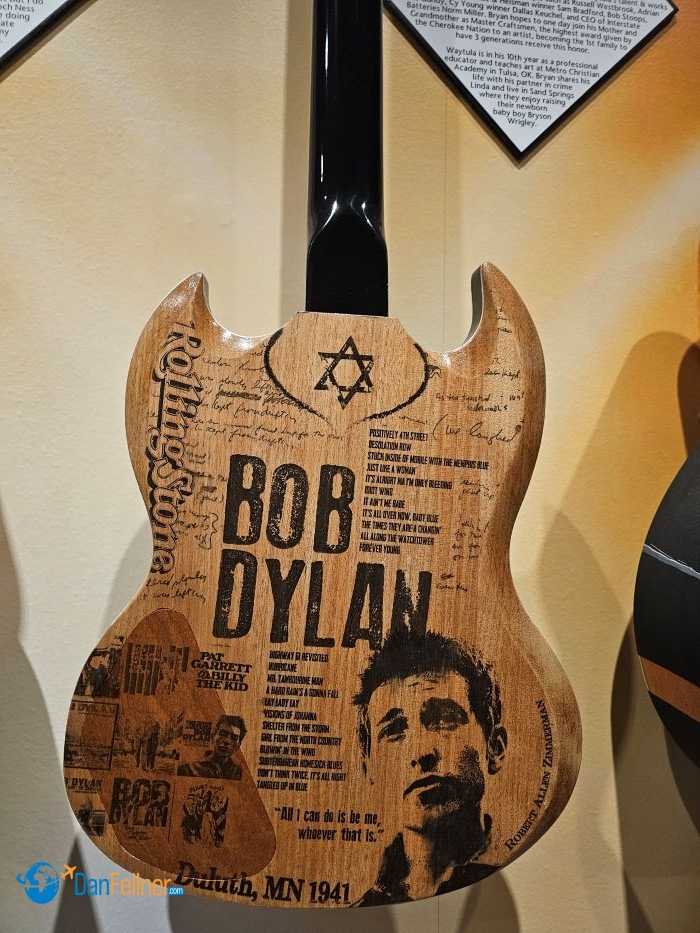
A hand-painted guitar on display in the “Jews Rock” exhibit at the Sherwin Miller Museum of Jewish Art. It was created by Cherokee artist Bryan Waytula.
Another guitar depicts Gene Simmons of Kiss with his famously long tongue protruding. The Israeli-born Simmons reportedly had his tongue insured for $1 million.
The “Jews Rock” exhibit opened seven years ago and originally was intended to be a temporary exhibit. But due to its popularity, the exhibit has been making a never-ending curtain call.
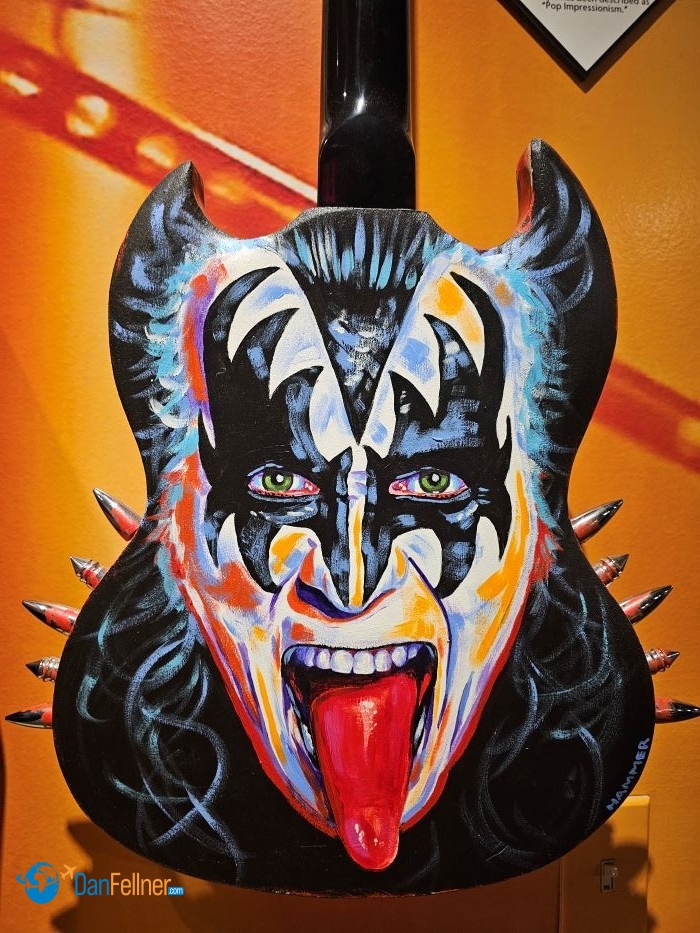
A hand-painted guitar showing Gene Simmons — and his famous tongue — at the “Jews Rock” exhibit in the Sherwin Miller Museum of Jewish Art.
“Students just fell in love with it,” says Tracey Herst-Woods, Sherwin Miller’s chief museum officer. “The kids would come in on tours and just stop and be mesmerized. When the exhibit came down after its temporary run, we realized very quickly we needed to find a place to continue the exhibit.”
The Sherwin Miller Museum originally opened in 1966 as the Gershon and Rebecca Fenster Gallery of Jewish Art, located at Congregation B’nai Emunah. It was later renamed – after the museum’s first curator — and moved to its current location in southwest Tulsa in 2003.
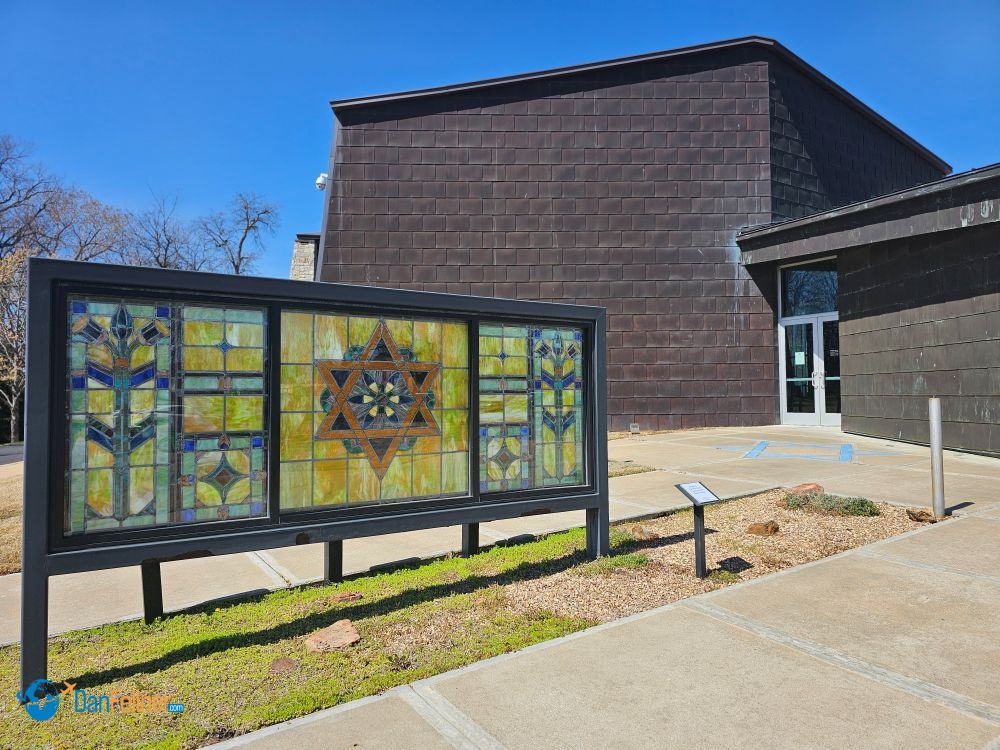
The Sherwin Miller Museum of Jewish Art, which houses some 8,000 artifacts, has been named the third-best Jewish museum in North America by Jewish Living Magazine.
The museum, which houses some 8,000 artifacts, has been named the third-best Jewish museum in North America by Jewish Living Magazine. Its cornerstone is the Sanditen/Kaiser Holocaust Center, which contains 250 items from soldiers and survivors never before seen by the public, including a Torah scroll rescued from Pribram, Czechoslovakia.
The exhibit relates the Holocaust to other hate-fueled tragedies, including Tulsa’s horrific 1921 Race Massacre during which much of the city’s affluent Greenwood District – known as “Black Wall Street” — was burned down. Herst-Woods says all eighth-grade students in Tulsa are required to visit the museum on a field trip.
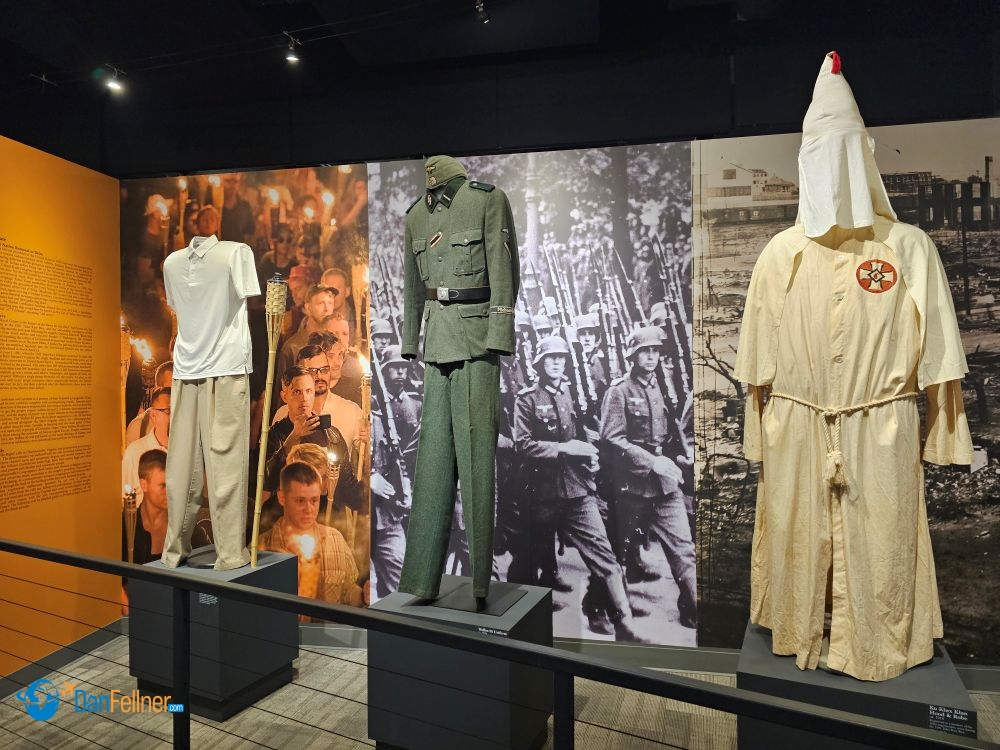
The Holocaust exhibit at the Sherwin Miller Museum of Jewish Art relates the Holocaust to other hate-fueled tragedies, including Tulsa’s horrific 1921 Race Massacre.
Across the hall from the “Jews Rock” exhibit, the museum also features the remnants of a shuttered synagogue from nearby Muskogee, Okla., home to one of the state’s first organized Jewish communities. Congregation Beth Ahaba served Muskogee’s Jews as a Reform synagogue for 100 years until dwindling numbers forced it to close in 2011.
Beth Ahaba donated its pews, lectern, bimah chairs, menorahs and arc cabinet to Sherwin Miller, where the items constitute a unique model synagogue that occasionally is used for children’s services.
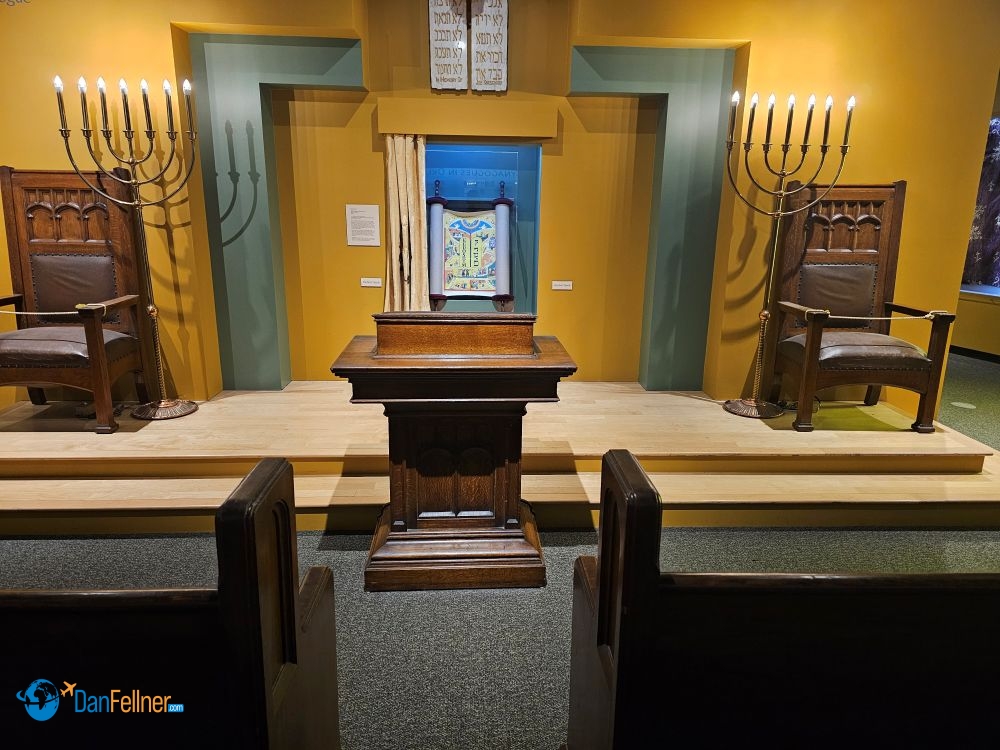
The remnants of a shuttered synagogue from Muskogee, Okla., on display inside the Sherwin Miller Museum of Jewish Art in Tulsa.
Muskogee has produced its own famous Jewish musician — jazz guitarist Barney Kessel. Born in 1923 to Russian-Jewish immigrants — his father owned a shoe store in Muskogee — Kessel started playing guitar professionally at the age of 14. He moved from Oklahoma to California in 1942 and performed with the likes of Benny Goodman and Charlie Parker. He later joined the Wrecking Crew, a group of stellar studio musicians. During the height of Kessel’s career, critics considered him one of the world’s most influential jazz guitarists.
Sherwin Miller is located on the 17-acre Zarrow Campus that also includes the Tulsa Jewish Community Center, a Jewish day school, a kosher retirement home and Jewish Federation offices. Herst-Woods estimates there are about 1,800 “active” Jews now living in Tulsa.
There are two working synagogues and a Chabad House to meet the community’s religious needs. In addition to the unaffiliated Congregation B’nai Emunah, Tulsa is home to a Reform congregation called Temple Israel that was founded in 1914.
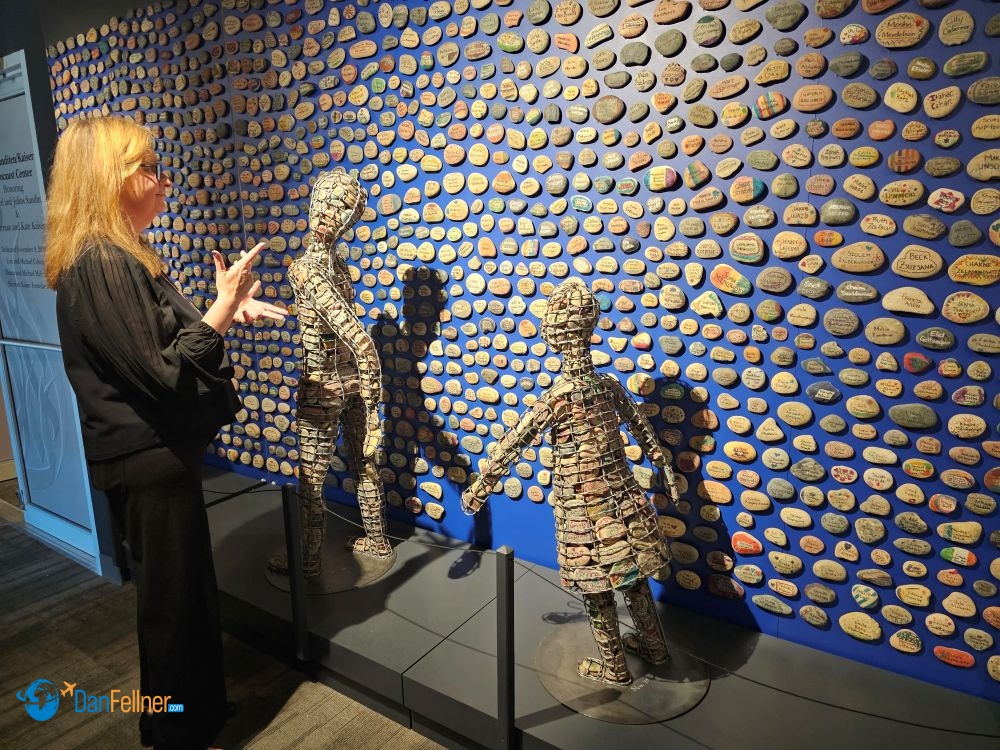
Tracey Herst-Woods, Sherwin Miller’s chief museum officer, discusses an exhibit inside the museum’s Sanditen/Kaiser Holocaust Center.
Temple Israel’s most recent building, located on East 22nd Place and dating back to 1955, was torn down in early 2026 and is now in the process of being rebuilt. It’s expected to be completed sometime in 2027. In the interim, services for the congregation are being held at the Zarrow Campus.
During my visit, I was able to visit Temple Israel’s construction site and see massive twin-pillar 42-foot-tall concrete tablets displaying the Ten Commandments. Created by a Tulsa artist, the tablets have been a recognized feature of the local landscape for more than 70 years.

Twin-pillar 42-foot-tall concrete tablets displaying the Ten Commandments at the construction site of Tulsa’s Temple Israel, which is scheduled to reopen in 2027.
The 90,000-pound structures had formerly graced the front of the synagogue. The tablets are being preserved during construction and will be placed outside a glass wall of the new sanctuary so that they’ll be visible to worshippers.
The Tulsa Jewish Federation has recently attracted global attention with an initiative called Lech L’Tulsa (Go to Tulsa), which is offering financial incentives and legal support to attract Jewish immigrants from Canada, where antisemitism has spiked to historic levels in recent years.
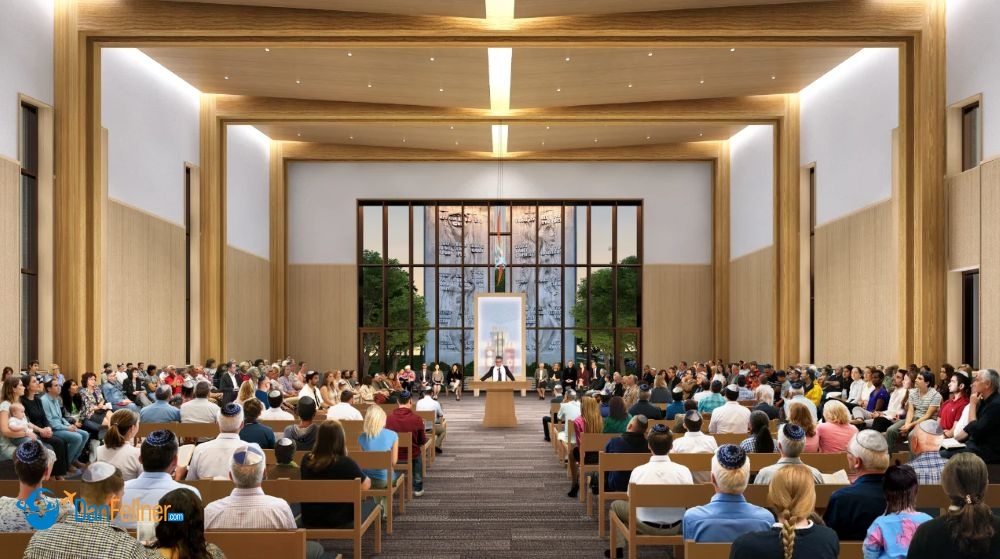
An artist’s rendering of the new sanctuary inside the rebuilt Temple Israel, expected to be completed in 2027. The concrete tablets displaying the Ten Commandments will be visible to worshippers through a large window. (Photo: Finegold Alexander Architects).
The program provides up to $4,000 in relocation assistance and sponsored weekend trips to the city. Lech L’Tulsa, funded in part by the Kaiser Family Foundation, is targeting Canadian Jewish families and professionals under 40. It builds on an existing program launched in 2017 by a group called Tulsa Tomorrow that has already helped relocate 143 Jews to Tulsa; about 80% still live in the area.
Roberts says that while it’s too soon to know how many Canadians might take advantage of the offer, interest thus far has exceeded expectations.
“Having moved from Canada myself, we knew that there would be interest,” says Roberts, who grew up in Ohio and formerly ran the Jewish Federation in London, Ontario. “I think we underestimated how much interest there would be.”
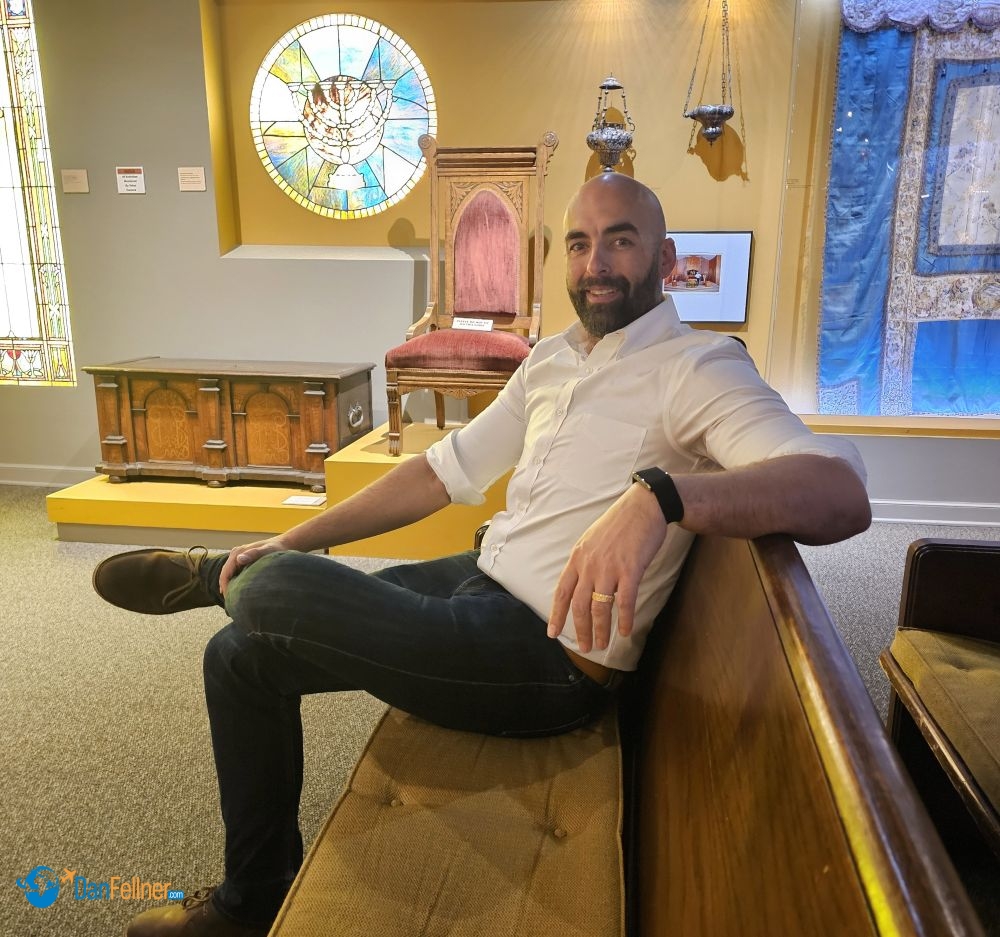
Joe Roberts, executive director of the Jewish Federation of Tulsa, inside the Sherwin Miller Museum of Jewish Art.
Roberts says the first trip to Tulsa several weeks ago of potential immigrants attracted 50 Canadians.
“I think they were blown away by Tulsa,” he says. “This is one of those types of places where you come with different expectations than you leave with. It’s going to take some time but we’ll see where it goes and we’re really hopeful about the outcome.”
© 2026 Dan Fellner