

Birthplace of world’s fastest-growing sport a bucket-list trip for pickleball fanatics
Pickleball Magazine, July 2026
BAINBRIDGE ISLAND, Wash. — On a glorious sun-drenched 70-degree summer day in the Pacific Northwest, our small group walks contemplatively along a secluded tree-lined dirt path, as if we’re approaching a venerated religious shrine.
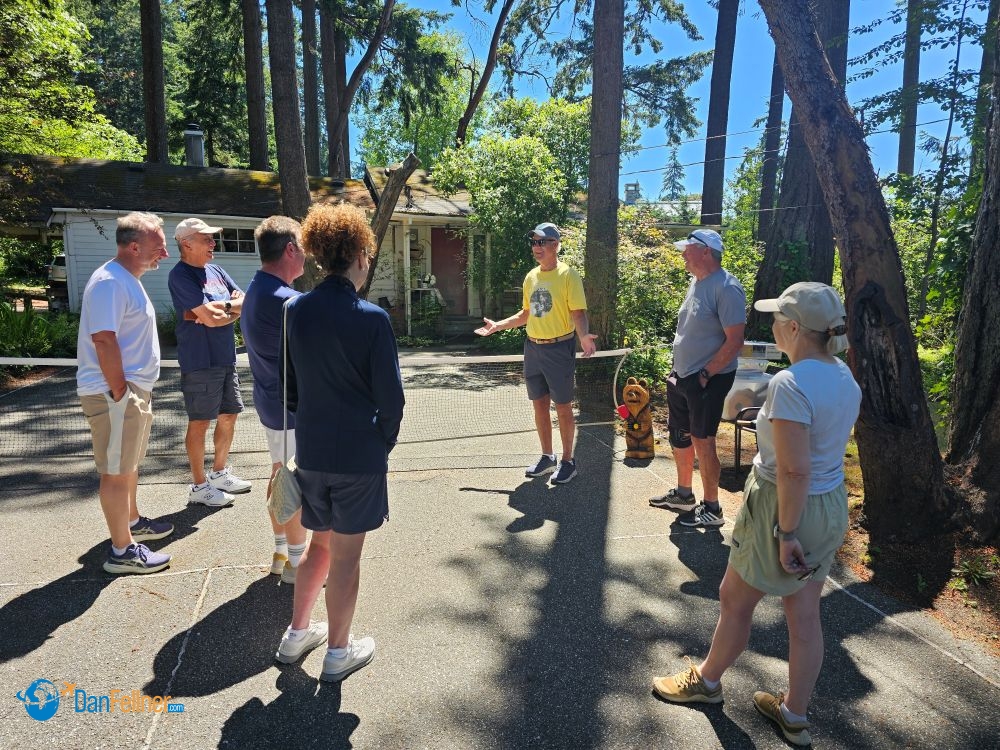
Scott Stover explains the history of pickleball to a group of visitors on the legendary Court 1 at his home on Bainbridge Island, where the sport was invented in 1965.
As we quietly pass a “no trespassing” sign at the base of a Pacific madrone evergreen, a clearing emerges, revealing one of the most celebrated slabs of asphalt since the Beatles were photographed crossing Abbey Road.
“So this is Mecca, right here,” says our host Clay Roberts, only partly tongue-in-cheek, pointing to the site where visitors have been known to joyfully kiss the pavement.
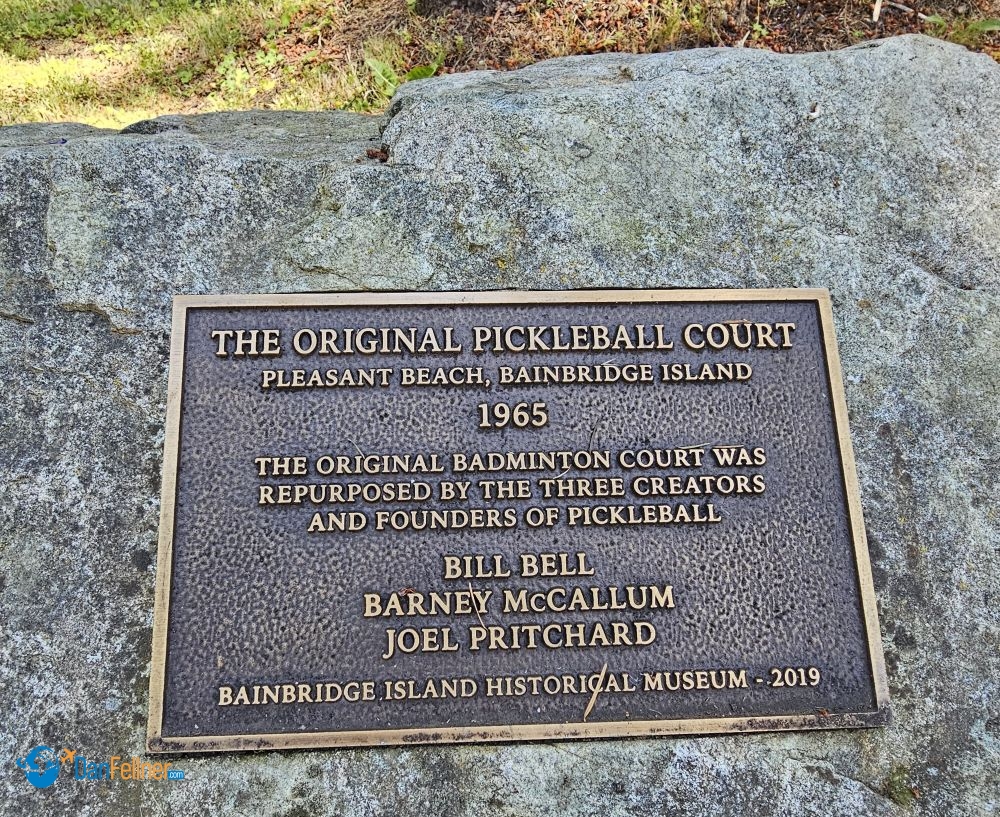
The historical marker next to Court 1, where pickleball was invented in 1965 on Bainbridge Island.
We had reached the hallowed ground of “Court 1,” where pickleball — America’s fastest-growing sport — was invented and first played more than 60 years ago on this scenic and affluent island.
Bainbridge Island is located in the Puget Sound about a half-hour ferry ride from downtown Seattle. It’s not a large island – about 5 miles wide and 10 miles long – with a population of about 25,000. The number of people on the island can swell to 35,000 in the summer when tourists invade Bainbridge, many of whom are day-trippers from Seattle.
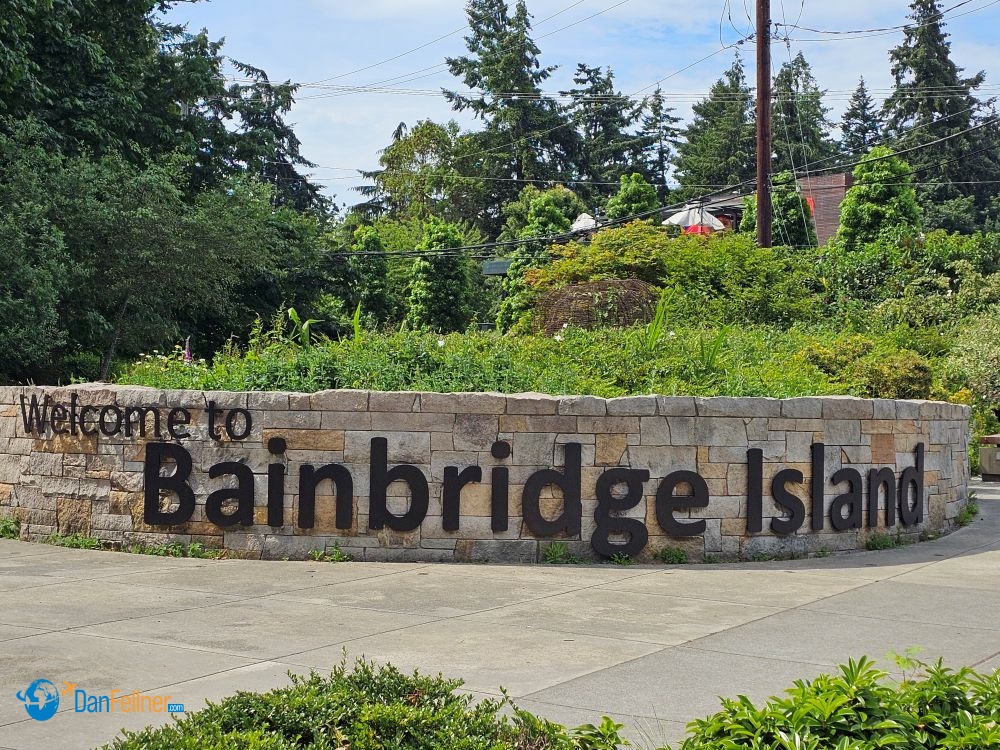
Bainbridge Island, a half-hour ferry ride from Seattle, is home to about 25,000 people.
Some of the visitors come on pickleball pilgrimages to see the birthplace of their favorite sport, play at 12 public courts dedicated to the game’s inventors, and buy pickleball-related souvenirs in the island’s gift shops.
“It’s a bucket-list for people to come to Bainbridge,” says Roberts. “We have people show up from all over the world just to say they’ve played here.”
Roberts, affectionally known on the island as “Mr. Pickleball,” introduced us to Scott Stover, the owner of the 100-year-old house who was waiting to greet us and tell the story of how pickleball got its start on the home’s driveway in 1965.
Friends Joel Pritchard (a former Washington congressman who owned the home at the time), Bill Bell and Barney McCallum spent summers on the island. When their children complained of boredom, Pritchard proposed they invent a new game using materials they had readily available, including a badminton net, table-tennis paddles and a Whiffle ball. A badminton court was repurposed and the three men developed rules to govern the new game.
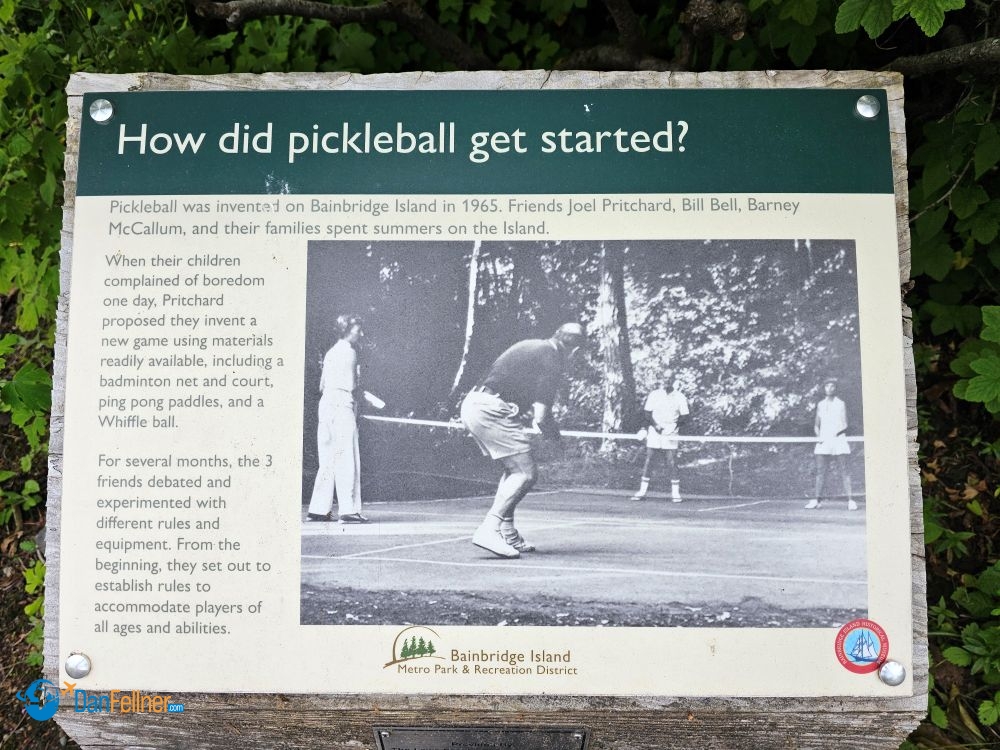
A sign in downtown Winslow, Bainbridge Island, explains the advent of pickleball in 1965.
How did pickleball get its quirky name? Roberts says it’s because the Pritchard’s cocker-spaniel, Pickles, loved to chase after the ball and run with it. Other accounts suggest Pritchard’s wife Joan named the game after a rowing term. A “pickle boat” carries a hastily assembled crew of leftover rowers, just as pickleball was created with leftover pieces from other sports.
Either way, the sport slowly evolved from a friendly game enjoyed in private backyards on Bainbridge to what is now a global phenomenon, played by an estimated 24 million Americans and as many as 50 million people worldwide in 80 countries.
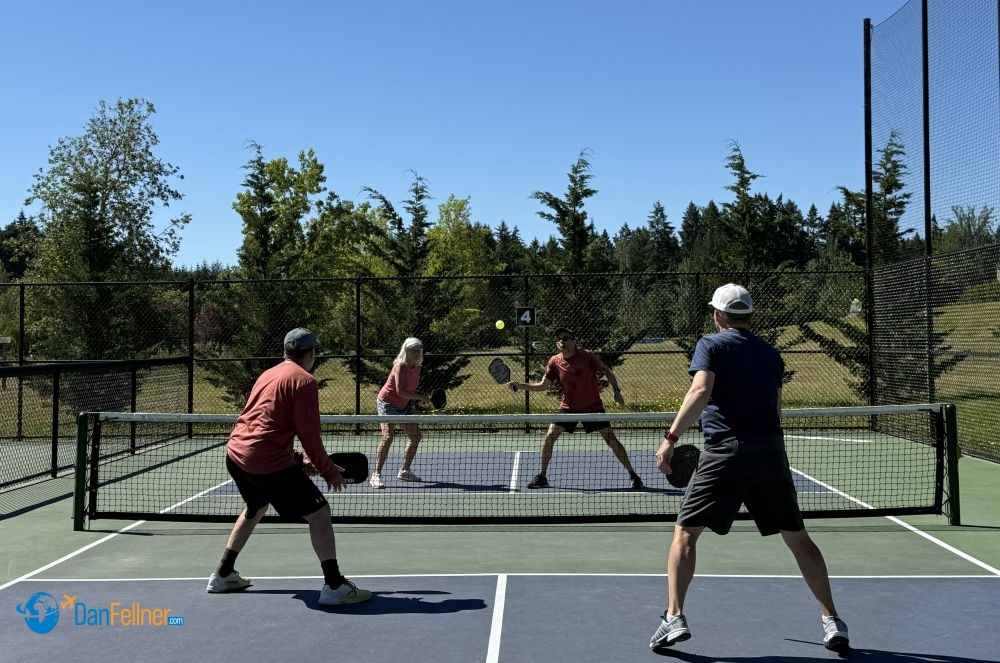
A pickleball match on Bainbridge Island, the sport’s birthplace. Pickleball is played by an estimated 24 million Americans and as many as 50 million people worldwide in 80 countries.
The pickleball industry is valued at around $3 billion and is supported by a booming ecosystem of equipment manufacturing, court construction and professional leagues. There’s even a 24/7 television network called PickleballTV.
Stover, 75, bought the house from the Pritchard family in 1984 (his wife Carol was Pritchard’s second cousin). Little did he know that his home would later become such an iconic spot for pickleball fanatics.
“It’s always been a surprise to us how it does touch certain people,” he says. “Pickleball is such an important part of lots of people’s lives.”
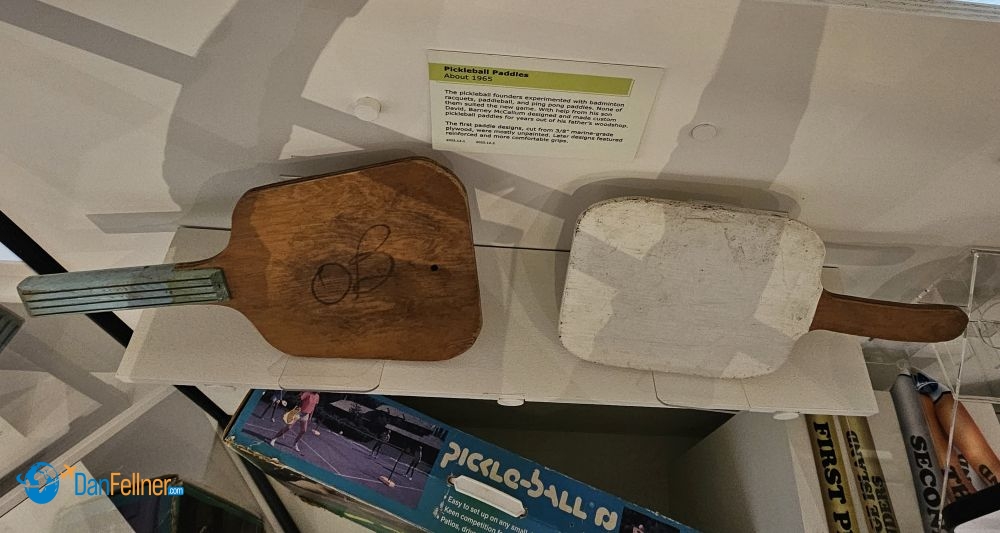
Pickleball paddles made from plywood dating back to 1965, when the sport was invented on Bainbridge Island. The paddles were crafted by Barney McCallum, one of the game’s inventors.
Stover, who calls himself “an anti-tourism guy,” prefers to keep the location of his home private and only occasionally allows visitors to see Court 1 – usually for charity events. Understandably, he doesn’t want unannounced tourists traipsing across his property.
With Stover’s permission, Roberts was kind enough to arrange a visit to the house. Our small group included a mix of locals and visitors from England.
I even got to hit a few balls with Roberts on Court 1. We played with wooden paddles, similar to what the game’s pioneers used. The asphalt surface was as bumpy as a bicycle speeding down a cobblestone road.
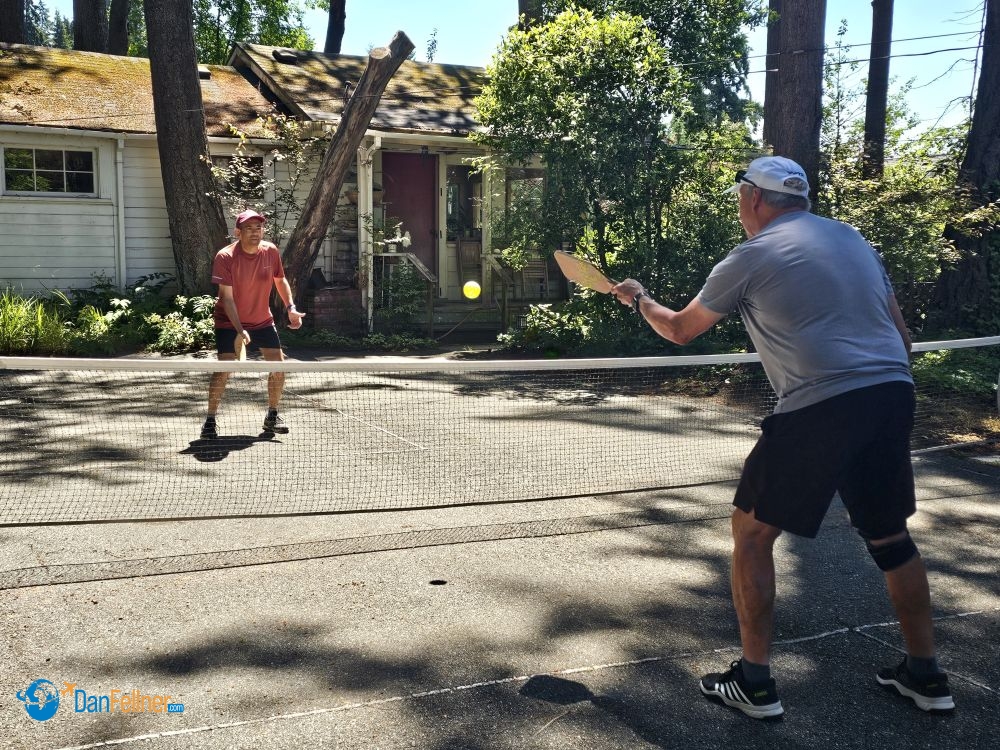
The author (far court) hitting a few balls with Clay Roberts on the iconic Court 1, where pickleball was invented in 1965.
“As you can see, the court has lots of flaws, whether tree roots or whatever,” says Stover. “It’s not really meant for play anymore. It’s a historical site.”
There’s a plaque next to the court proclaiming it “the original pickleball court.” The marker was mounted in 2019 on a large boulder by the Bainbridge Island Historical Museum.
Stover started playing pickleball at the age of 16 with McCallum. In the mid-1970s, he won three world championships in doubles, although he acknowledges that the sport was still in its infancy and most of his fellow competitors in those days were from the Pacific Northwest.
“We were world champions, but the pickleball world was a small place back then,” he recalls with a smile. “It was a very slow growth.”
Stover brought out a rare boxed set of pickleball gear that was sold by Pickle-ball Inc., a company founded by the sport’s inventors in 1972. These early starter kits included four wooden paddles, balls, a net and an official rulebook. There’s a photo on the cover of the box showing Stover – then in his mid-20s — smashing a ball.
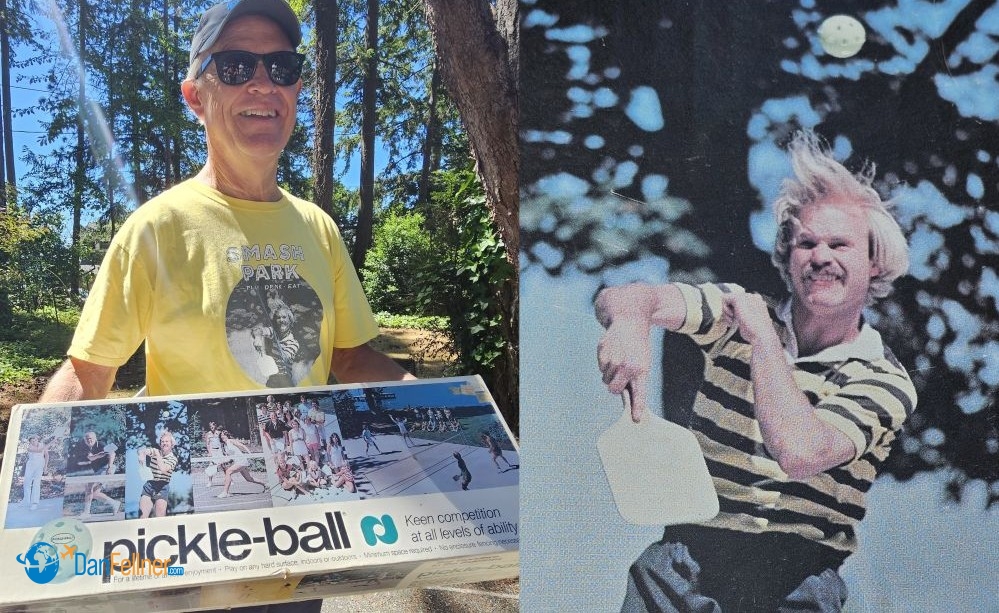
Left: Scott Stover displays a rare boxed set of pickleball gear that was sold by Pickle-ball Inc., a company founded by the sport’s inventors in 1972. Right: Stover was a three-time doubles world champion in the 1970s.
While Court 1 is not open to the public, there is an outdoor complex at which visitors can play for free that celebrates the game’s inventors. The Founders Courts in Battle Point Park opened in 2021 with six courts and has since been expanded to 12. Roberts and fellow pickleball player Bill Walker spearheaded the effort to raise money to build the courts.
“My business during COVID dropped off and I’m not good at sitting around, so this was a perfect project to work on,” says Roberts, 77, who has lived on the island for 40 years. “I thought we were building courts, but as it turned out, we were building community.”
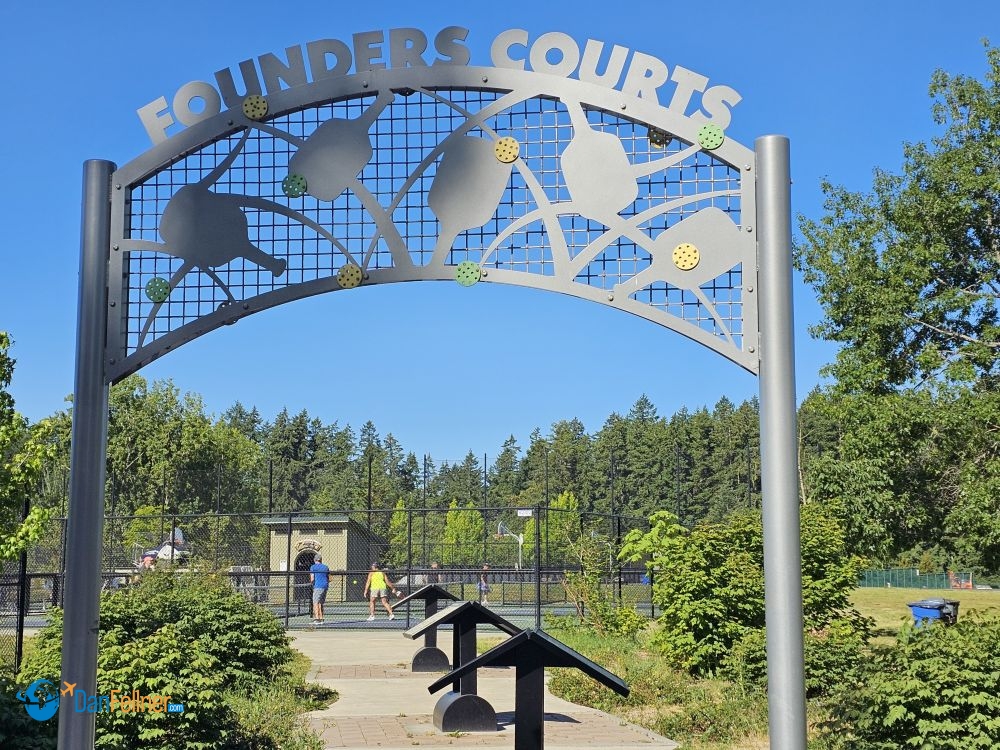
The Founders Courts in Battle Point Park opened in 2021 as a tribute to pickleball’s inventors. The complex is free and open to the public.
The complex includes an ornamental iron gate crafted by a local artist and displays detailing the history of the sport. My wife and I played for two hours at the Founders Courts and found the locals warm and welcoming. It reminded us of one of the things we cherish most about pickleball – the game’s camaraderie and inclusiveness.
“I think it’s what’s missing in America today,” says Roberts. “I’ve watched a member of the LGBTQ community playing with a Trumper and at the end of it they’re high-fiving each other and fist-pumping. I turned to my partner and said ‘this never would have happened without pickleball.’”
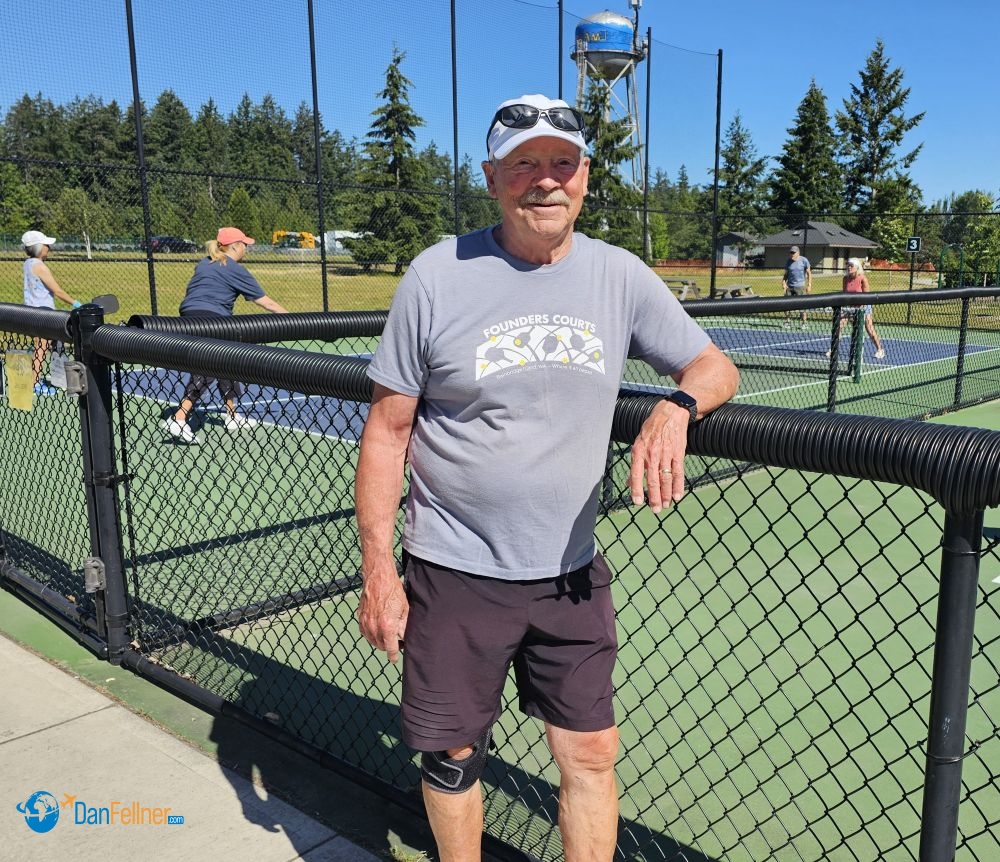
Clay Roberts, affectionally known on Bainbridge as “Mr. Pickleball,” spearheaded the fundraising campaign to build the Founders Courts.
The highlight of Bainbridge’s pickleball calendar comes each August when 400-500 players compete in the annual Founders Tournament at Battle Point Park. The five-day event serves as a fundraiser for the Bainbridge History Museum and attracts players from all over the world.
Roberts was instrumental in getting his friend and fellow Bainbridge Island resident – former Washington Gov. Jay Inslee – to sign a law declaring pickleball the official state sport in 2022. Fittingly, Inslee signed the proclamation at a ceremony held on Court 1.
“We did not have a state sport and it provided more visibility for the game,” says Roberts of his informal lobbying of the governor. “I would have been disappointed if some other state would have beat us to the punch.”
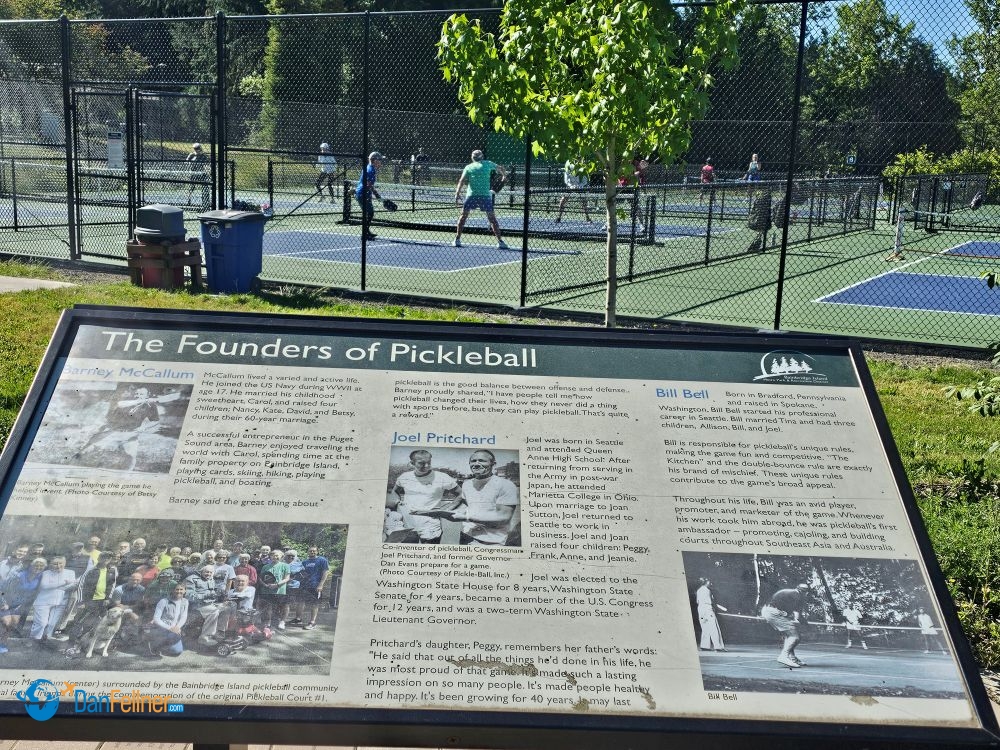
The Founders Courts pays tribute to Barney McCallum, Joel Pritchard and Bill Bell, who invented the sport on Bainbridge Island in 1965.
Downtown Bainbridge Island, officially known as Winslow, spans about 10 blocks and is a short walk from the ferry terminal.
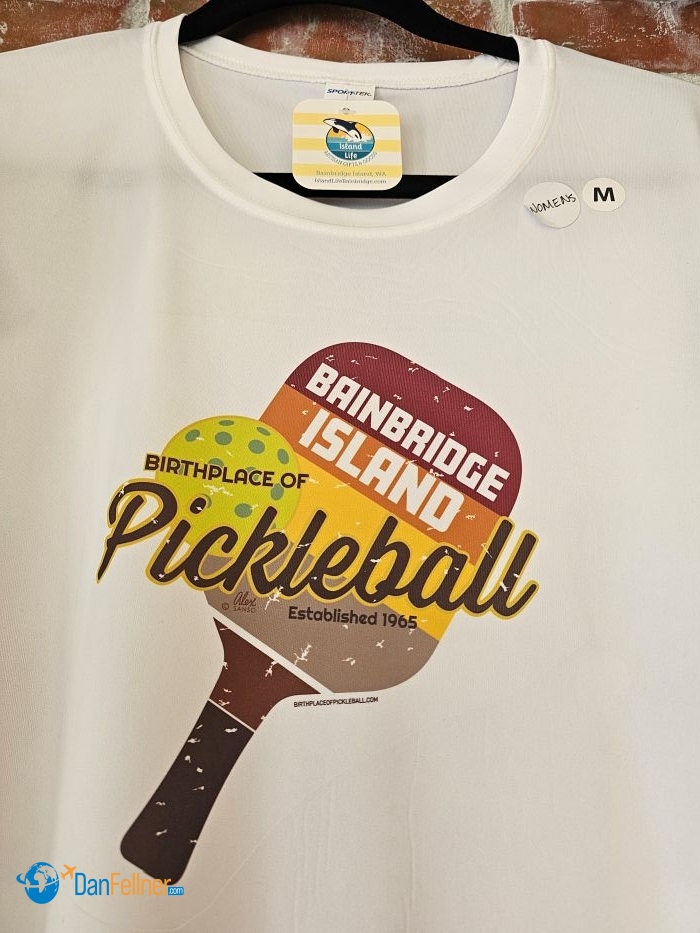
We popped into the Island Life Artisan Gifts shop on Winslow Way and were amazed to see a large section of the store devoted to pickleball souvenirs, including paddles, balls, fridge magnets, hats, shirts and even pickleball playing cards.
Owner Alex Sanso, a former Disney merchandise artist who designed many of the shop’s pickleball products, came up with a clever catchphrase emblazoned on some of the souvenirs: “Born here, played everywhere.” Sanso told me that pickleball-related merchandise constitutes about 50% of the shop’s sales.
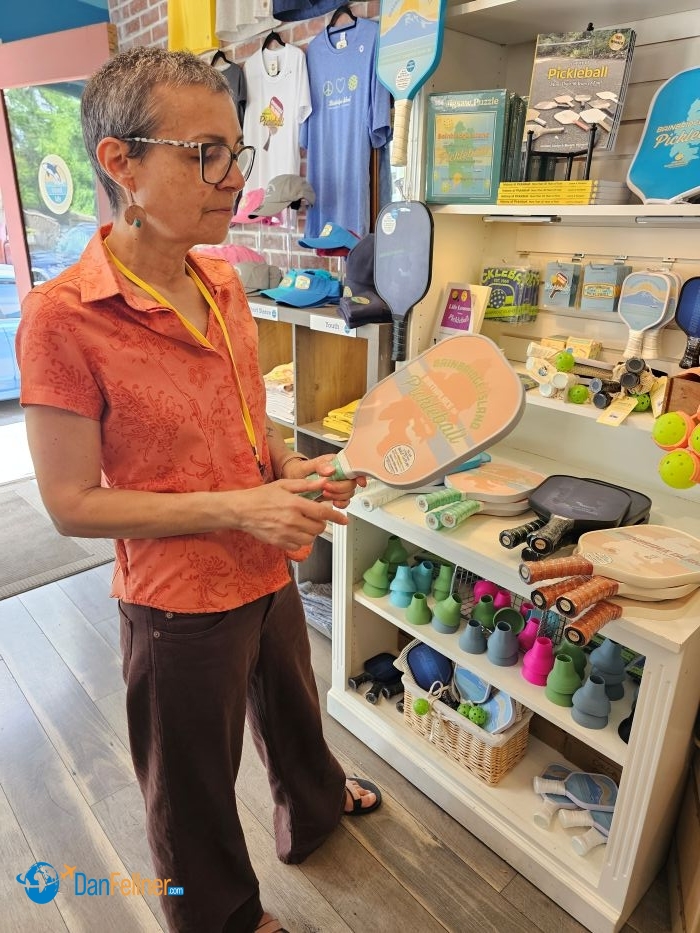
Alex Sanso, owner of the Island Life Artisan Gifts shop on Bainbridge Island, shows some of her pickleball-related merchandise for sale. About 50% of the store’s sales are pickleball souvenirs.
“People’s minds are blown when they realize this is the birthplace of pickleball,” she says.
Around the corner, the Bainbridge Historical Museum – housed in a restored one-room schoolhouse dating back 1908 — features a prominent display on the island’s pickleball history.
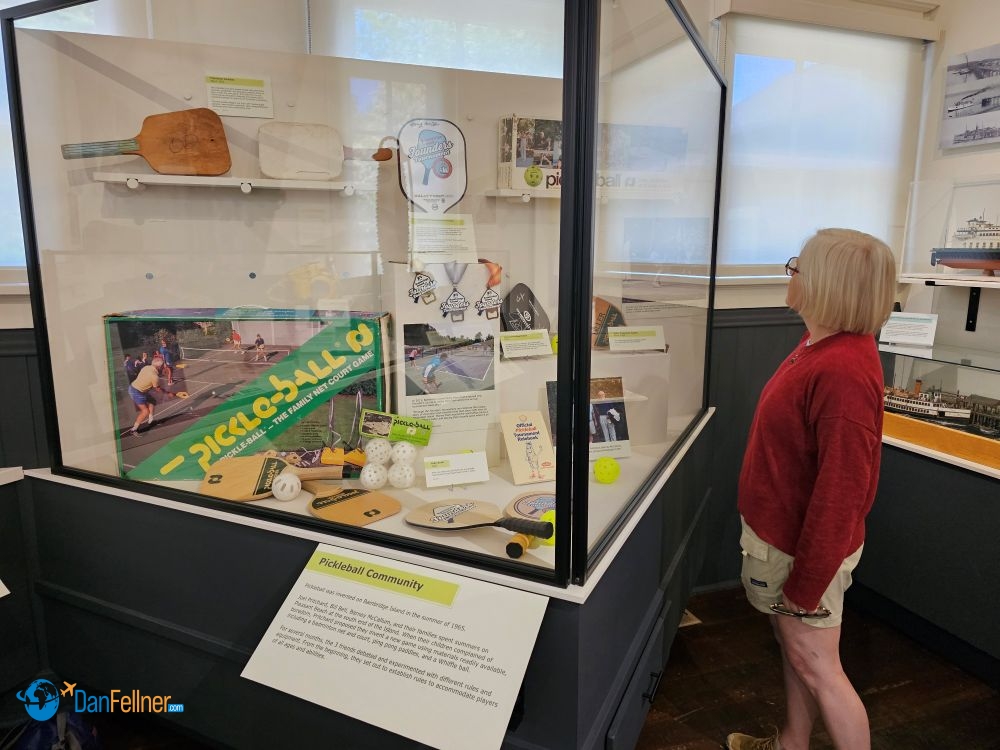
An exhibit at the Bainbridge Historical Museum chronicles the history of pickleball, which was invented on the island in 1965.
I especially enjoyed seeing two of the sport’s first paddles, which McCallum crafted from plywood in his father’s woodshop. Conversely, today’s high-tech paddles are made from materials like carbon fiber, graphite and fiberglass, and can cost up to $400. That’s not to say, though, that beginning and intermediate players need to shell out a lot of money for a paddle. As an example, the Halo X5 carbon fiber paddle made by Joysent can be had for just $60.
Justin Reichman, director of tourism for Visit Bainbridge Island, the island’s official destination marketing organization (DMO), says while the exact number of pickleball tourists to Bainbridge isn’t tracked, “pickleball is clearly part of the draw.” Reichman adds the DMO sees an opportunity to learn further into marketing pickleball as a way to attract more visitors to the island.
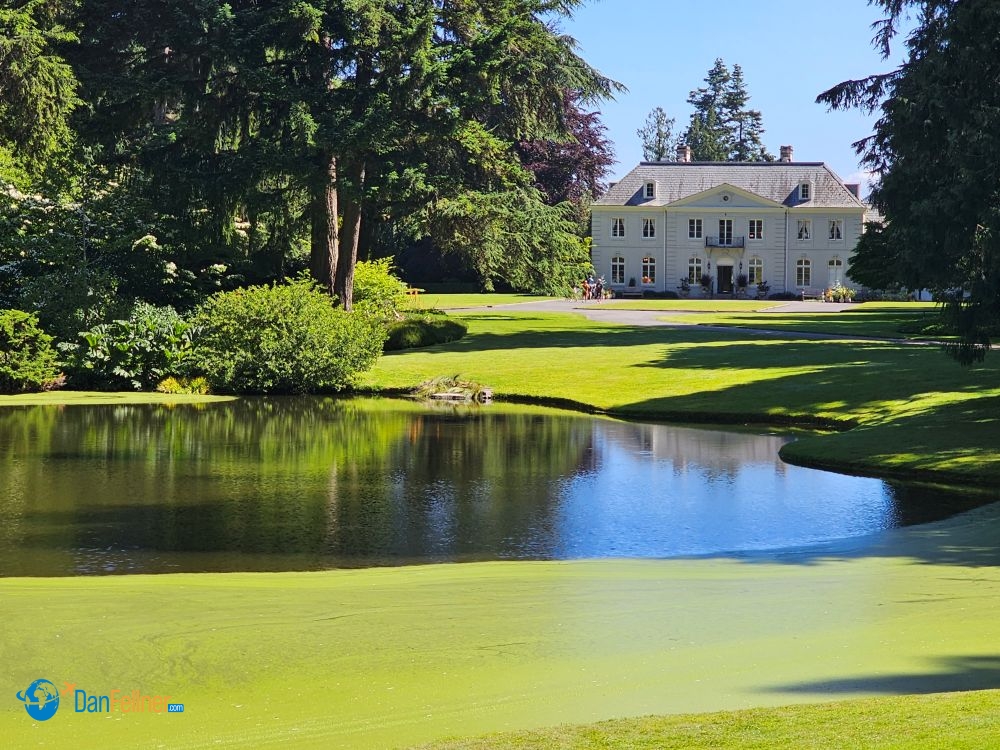
The Bloedel Reserve, 140-acres of gardens, forests, lakes and a historic home, is one of Bainbridge Island’s most popular attractions.
“Ideas like partnering with clubs beyond the island or building pickleball-focused itineraries are what we’re excited to explore as our tourism program grows,” Reichman says. “Nothing is locked in yet, but it’s a space we’re watching closely.”
Reaching Court 1 on Bainbridge Island was far more arduous than rallying from a 10-0 pickleball deficit. To get there, I needed to take a plane from Phoenix to Seattle, light rail from the Sea-Tac airport to Colman Dock, a ferry across the Puget Sound, and a bus on Bainbridge to Battle Point Park, where Roberts picked us up for the 10-minute drive to Court 1 at Stover’s house.
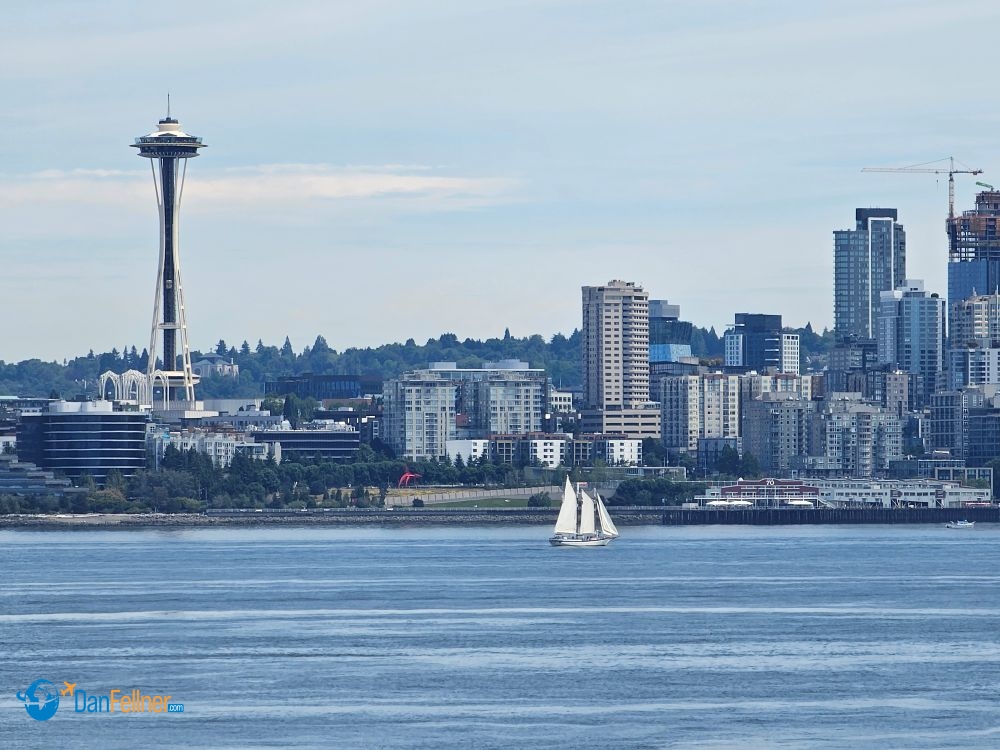
The view of downtown Seattle from the ferry to Bainbridge Island.
But the journey was well worth it. I had set foot on the revered birthplace of the sport that millions of people find so enriching. Finally, I had attained pickleball nirvana.
Now if I could only master the third-shot drop.
© 2026 Dan Fellner